


Compact Loader Versatility for Seasonal Snow Clearing and Grounds Management
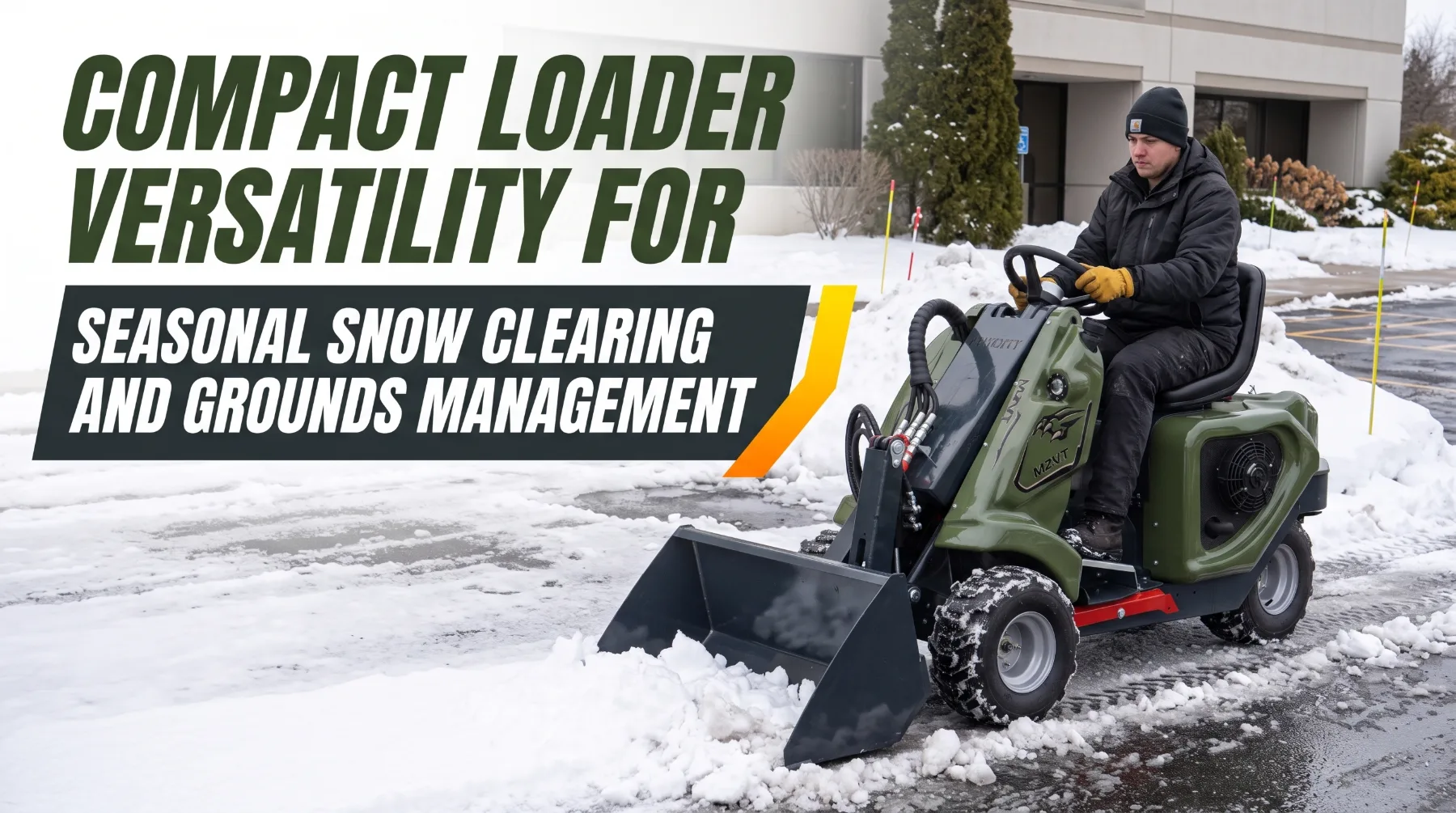
Changing weather brings different demands to property maintenance crews throughout the year. Winter work may involve clearing snow from parking lots, entrances, and walkways, while warmer months call for moving soil, spreading mulch, removing leaves, and maintaining landscaped areas. Facility managers and contractors need equipment that can handle these tasks without requiring a separate machine for every season.
Versatile compact loaders can support year-round grounds work through their small footprint and interchangeable attachments. Snow blades or suitable snow-handling attachments help clear access routes, while buckets and other approved tools support landscaping and debris removal. Matching the attachment to the task allows one machine to serve different maintenance needs as conditions change.
Seasonal performance depends on more than attachment selection. Wet snow and dense materials can create heavy loads, while icy surfaces may reduce traction and steering control. Operators should follow rated capacity limits, assess surface conditions, use smooth movements, and avoid attachments or techniques outside the manufacturer’s intended applications. Regular seasonal inspections and appropriate setup help maintain safe, dependable operation across changing weather and workloads.
Seasonal Attachment Options
Attachments make a compact loader versatile. Each one is built for a specific type of work, and choosing the right one for the task affects productivity, surface protection, and safety.
For winter work, the most common options include:
- Snow pushers: Built to move large volumes of snow across open, paved areas such as parking lots and wide driveways. The side panels contain the snow as the loader travels, so more material moves with each pass.
- Snow buckets: Larger and lighter-duty than standard buckets. They help scoop, carry, and relocate snow, especially when piles must be moved away from entrances, drive lanes, or drainage areas.
- Angle brooms: Useful for light snowfall, finishing passes, and clearing walkways or pavement where a cleaner surface is needed. They work best on lighter snow rather than deep or compacted accumulations.
- Standard buckets: Versatile for loading, carrying, and stacking snow, and for spreading approved de-icing material where the site plan allows it.
Each attachment serves a different purpose. A snow pusher clears open areas efficiently, but it is not designed to lift or stack snow. A bucket collects and relocates piles, but it moves less snow per pass across a wide lot. Many crews use both, pushing snow into designated piles first and then relocating those piles with a bucket when space runs out.
When warmer weather returns, the same loader can switch to landscape attachments such as general-purpose buckets, grapples, pallet forks, or other tools the manufacturer approves for the machine. The key word is compatible. Every attachment should match the loader’s mounting system, hydraulic requirements, and rated operating capacity.
Before mounting any attachment, confirm that:
- The attachment is approved for use with the specific loader model.
- The mounting interface locks fully and securely.
- Hydraulic connections, where required, match the loader’s auxiliary system.
- The combined weight of the attachment and its expected load stays within the machine’s rated capacity.
Key takeaway: Match each attachment to the task and the season, confirm compatibility with the loader before mounting, and use pushers, buckets, and brooms for the specific jobs they are designed to handle.
Maneuvering Around Maintained Areas
Compact loaders are valued for their ability to work in tight spaces. Their dimensions let them operate around parking spaces, walkways, landscaping beds, loading areas, and building entrances where larger equipment cannot fit. That same environment is full of things that can be damaged: curbs, light poles, bollards, planters, irrigation heads, signage, parked vehicles, and building facades.
Compact size does not remove the need for clearance planning. Before clearing or working in any area, consider the full machine envelope:
- Machine width: The loader’s overall width, including tires or tracks.
- Attachment width: Snow pushers and brooms are often wider than the machine itself.
- Turning path: The rear of the loader swings as it turns, and that swing can contact objects the operator is not watching.
- Raised attachment height: Overhangs, canopies, signage, and low branches can sit within reach of a raised bucket.
Walk the property before the season begins and identify hazards that may disappear under snow. Curbs, parking blocks, speed bumps, drain grates, walkway edges, and landscape borders can all be hidden by even a few inches of accumulation. Marking these features with snow stakes or reflective markers before the first storm helps operators avoid striking them and protects both the machine and the property.
Surface damage is another concern. Tight turns, especially pivot or counter-rotation turns on skid-steer-style machines, can scuff pavement, tear turf, and break down landscape edges. The risk increases when the ground is soft, such as during a thaw or after heavy rain. Use wider, gradual turns where space allows, and avoid driving onto turf or planting beds unless the work requires it and the ground can support the machine.
People also share these spaces. Pedestrians, residents, employees, and delivery drivers may move through the work area, often during early-morning clearing when visibility is low. Keep the machine’s lights on, watch for people near entrances and walkways, and stop when anyone enters the travel path. Where visibility is limited, use a spotter who stays in a safe, visible position.
Key takeaway: Plan clearance for the machine, attachment, and turning path, mark hidden obstacles before snowfall, and use gradual turns to protect pavement, turf, and landscape edges.
Traction on Snow and Ice
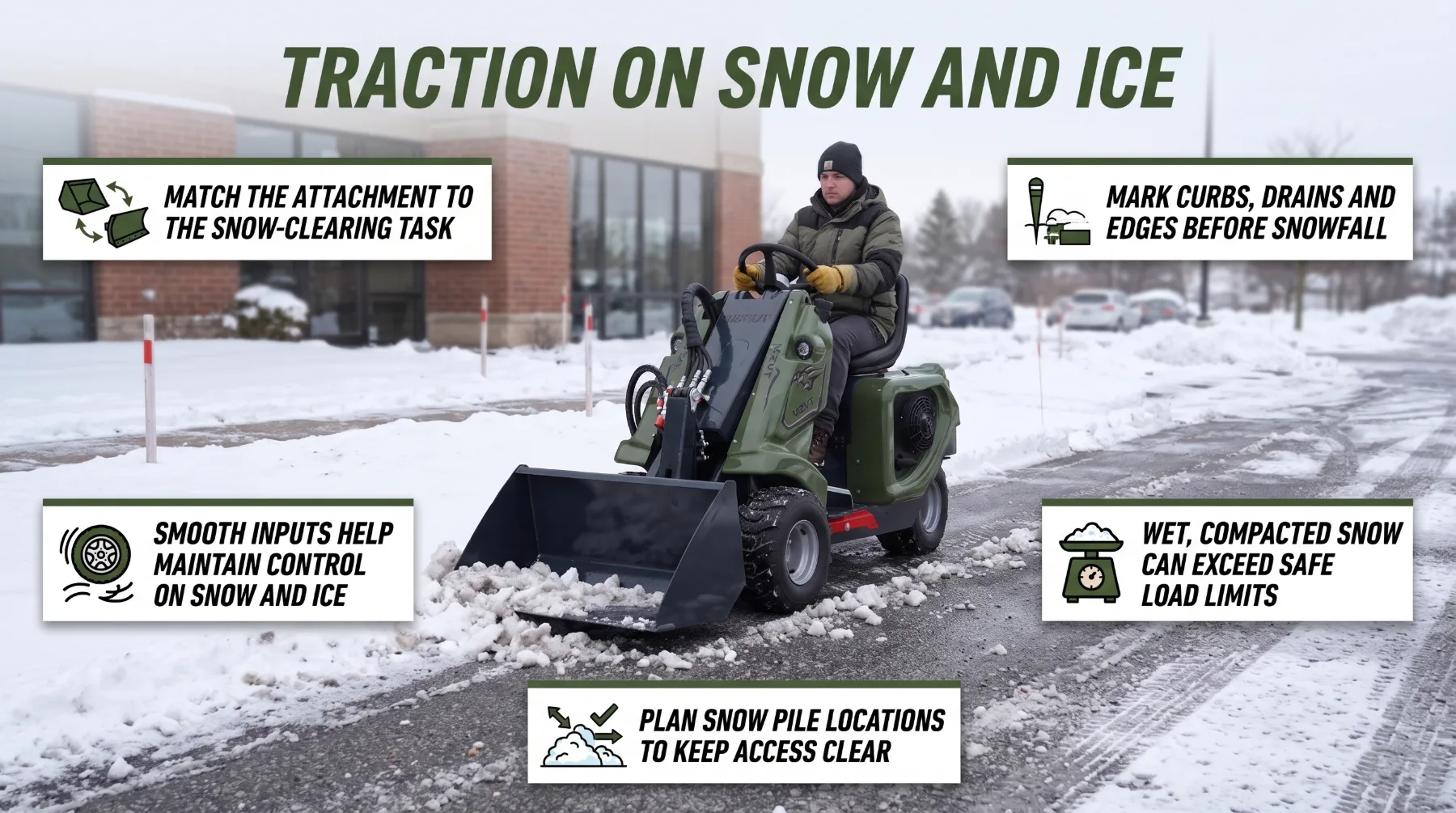
Traction determines how well a compact loader can push, carry, turn, and stop. On snow and ice, traction can change from one section of the property to the next, and the operator has less margin for error.
Tire or track selection plays a major role. Different tire tread patterns and track designs perform differently on snow, ice, pavement, and turf. Some provide stronger grip in loose snow, while others are better suited to hard surfaces or reducing turf damage. Review the manufacturer’s recommendations and choose the configuration that suits the property’s surfaces and typical winter conditions. Keep tires inflated to the specified pressure, since improper pressure affects both traction and stability.
Operator technique matters just as much as equipment. On slippery ground:
- Accelerate gradually: Sudden throttle or drive inputs can spin tires or tracks and cause the machine to slide.
- Turn smoothly: Sharp turns on slick surfaces can break traction and send the machine sideways, especially when carrying a load.
- Brake early and gently: Allow extra stopping distance, particularly on slopes and near curbs, vehicles, and buildings.
- Reduce speed: Travel at a pace that allows full control on the worst surface in the work area, not the best.
- Keep loads low: A low bucket keeps the center of gravity down and improves stability on uneven, slippery ground.
Slopes deserve special caution. A grade that is easy to work in dry conditions can become hazardous when covered with snow or ice. Travel up and down slopes rather than across them where the manufacturer’s instructions call for it, and stay within the machine’s permitted slope limits. If the loader begins to slide, avoid abrupt corrections that could make the situation worse.
Ice presents a particular challenge. A compact loader cannot guarantee safe traction on every surface. Black ice, refrozen meltwater, and glazed pavement may require treatment with approved de-icing materials or manual removal before machine work continues. When conditions are unsafe, stop and use alternate methods rather than forcing the machine through.
Key takeaway: Choose tires or tracks suited to the property’s winter surfaces, operate with smooth, gradual inputs, and treat ice or stop work when the loader cannot maintain safe traction.
Managing Snow Piles and Material Loads
Snow looks light, but it can be surprisingly heavy. Its weight changes with moisture content, temperature, and how long it has been on the ground. Fresh, dry powder is relatively light. Wet snow, snow packed by traffic, and snow that has partially melted and refrozen can be many times heavier for the same volume.
This difference matters because a bucket filled with heavy snow may exceed the loader’s rated operating capacity even when it does not look full. Operators who judge loads by appearance alone risk overloading the machine, which can reduce stability, strain hydraulic and structural components, and increase the chance of a tip.
Before lifting or carrying snow, account for:
- Snow condition: Wet, compacted, or icy snow weighs far more than fresh, dry snow.
- Attachment weight: A large snow bucket adds its own weight to the total load the machine must handle.
- Load position: A load carried farther forward or raised higher has a greater effect on stability.
- Fill level: Reduce the fill level when handling dense material rather than filling the bucket to the top.
- Ground conditions: A slippery or uneven surface reduces the margin for error with a heavy load.
Visibility also changes with the load. A full bucket, a raised attachment, or a tall snow pile can block the operator’s forward view. Carry the bucket low during travel, raise it only when positioned at the pile, and slow down during the final approach.
Planning snow storage locations helps keep operations efficient and safe. Good pile locations:
- Stay clear of building entrances, fire hydrants, fire lanes, and emergency access routes.
- Avoid blocking sightlines at driveways, intersections, and pedestrian crossings.
- Sit away from storm drains where meltwater should flow, and where meltwater will not refreeze across walkways.
- Do not damage landscaping, fences, or structures under the weight of the pile.
When stacking snow, avoid driving onto the pile or building piles so high that the loader must work at an unstable angle or with an extended lift. As piles grow through the season, plan to relocate snow before storage areas run out.
Key takeaway: Treat snow weight as variable, reduce fill levels for wet or compacted snow, account for attachment weight and load position, and plan pile locations that keep access routes, drains, and sightlines clear.
Grounds Management Beyond Winter
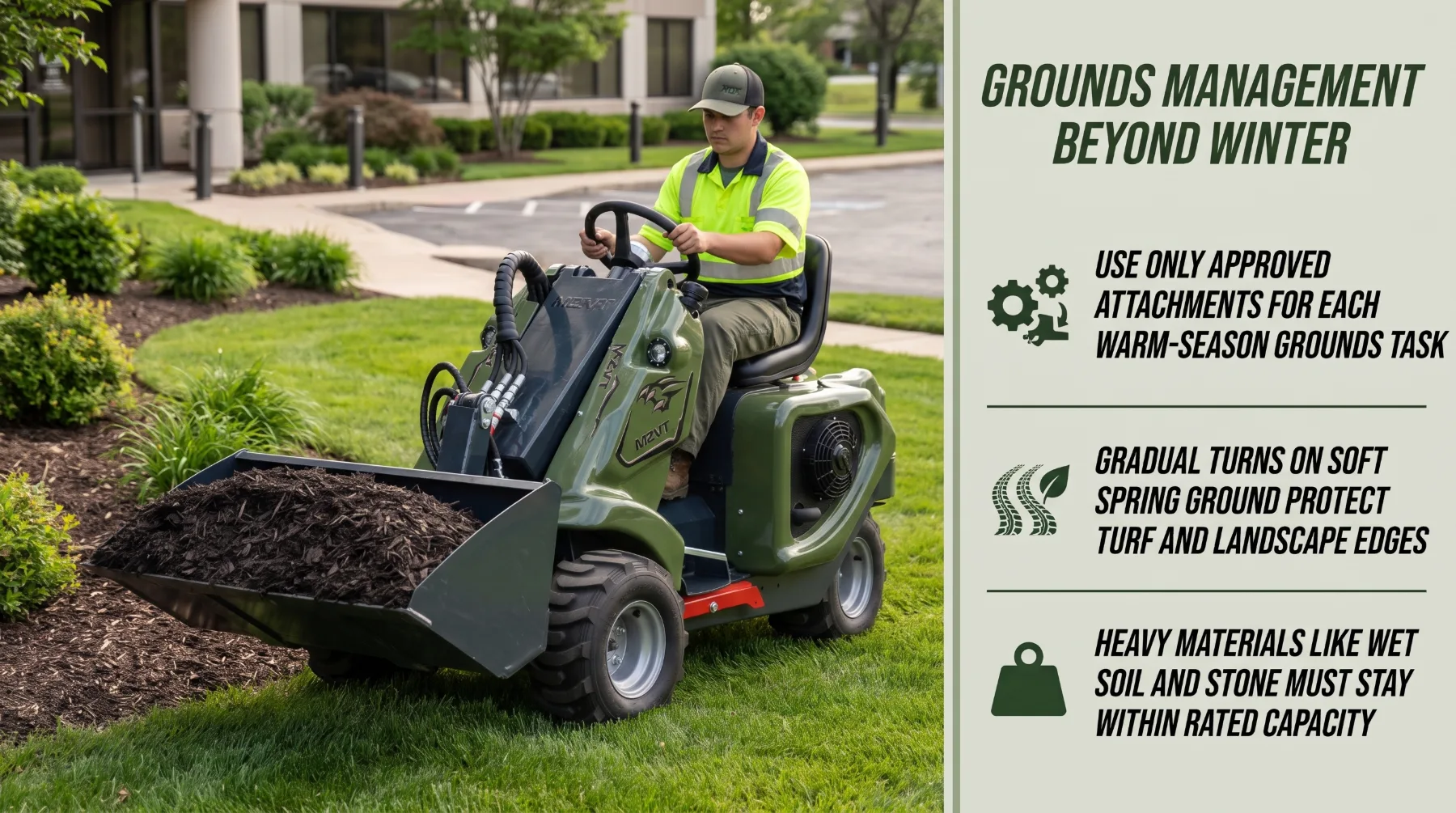
Once the snow melts, the compact loader’s work continues. Spring and summer bring a different set of ground management tasks, and the same machine can handle many of them with the right approved attachments.
Common warm-season tasks include:
- Moving soil: Delivering topsoil to planting areas, filling low spots, and preparing beds.
- Spreading mulch: Transporting mulch from delivery piles to landscape beds across the property.
- Clearing leaves and debris: Collecting storm debris, fallen branches, and seasonal leaf buildup.
- Handling landscaping materials: Moving stone, pavers, plants on pallets, and other supplies where approved attachments allow.
- Site cleanup: Clearing winter sand, gravel, and debris from parking areas and edges.
Material density matters in summer just as it does in winter. Mulch and leaves are light, while topsoil, sand, gravel, and stone are much heavier, especially when wet. A bucket full of saturated soil may weigh far more than the same bucket full of mulch. Keep every load within the machine’s rated operating capacity, including the attachment weight.
Before switching from winter work to ground tasks, take time to inspect the machine and attachments. Winter conditions are hard on equipment, and problems that developed during snow season should be found before warm-season work begins. Check:
- Attachment interface: Confirm the mounting plate, locking pins, and latching mechanism are clean, undamaged, and lock securely.
- Hydraulic connections: Inspect couplers and hoses for wear, cracks, and leaks, and clean couplers before connecting.
- Machine condition: Look for damage from winter impacts, corrosion from de-icing materials, and wear on tires or tracks.
Use each attachment only for the work it was designed to perform. A snow pusher should not be used to grade soil, and a light material bucket should not be used to pry out stumps or dig into hard ground. Misusing attachments can damage the attachment, the loader, and the property, and it can create serious safety hazards.
Turf protection becomes more important in warmer months. Soft spring ground marks easily, so plan travel routes along paved surfaces where possible and avoid sharp turns on lawns.
Key takeaway: Use approved attachments for spring and summer tasks, keep heavy materials such as wet soil and stone within rated capacity, and inspect the attachment interface, hydraulics, and machine condition before switching seasons.
Routine Checks for Seasonal Work
Seasonal work places changing demands on a compact loader. Cold weather affects batteries, fluids, and hydraulics, while warmer months bring dust, debris, and heavier material loads. A consistent inspection routine keeps the machine ready and helps prevent breakdowns during the times you need it most, such as the middle of a snowstorm.
Cold weather makes several systems especially important:
- Battery condition: Cold temperatures reduce battery performance. Check terminals for corrosion, confirm connections are tight, and test the battery before winter begins.
- Engine starting: Follow the manufacturer’s cold-start procedure and allow the recommended warm-up period before working.
- Hydraulic response: Cold hydraulic fluid can make functions feel slow. Allow the system to warm up according to the manufacturer’s guidance before applying full loads.
- Tire pressure: Pressure drops as temperatures fall. Check and adjust to the specified pressure regularly.
- Fluid specifications: Use fuel, engine oil, hydraulic fluid, and coolant that meet the manufacturer’s specifications for the operating temperature range.
Before every shift, complete a walk-around inspection with the machine parked on a suitable surface, the attachment lowered, and the engine off. Look for hydraulic leaks, damaged hoses, loose fasteners, and attachment security. Use a piece of cardboard rather than your hand to check for hydraulic leaks, since pressurized fluid can cause serious injury.
Snow and ice create their own hazards. Remove packed snow and ice from:
- Steps and handholds: Maintain three points of contact when entering and exiting, and clear slippery buildup first.
- Controls and pedals: Snow and ice can interfere with control movement and footing.
- Lights and mirrors: Clear lenses so the operator can see and be seen.
- Cooling areas: Packed snow around radiators and air intakes can restrict airflow.
At the end of each shift, park the loader on a suitable, firm surface with the attachment lowered to the ground. In freezing conditions, avoid parking where tires or tracks may freeze into mud or slush. Follow the manufacturer’s procedures for storage, fueling, and protection in freezing temperatures. Clean salt and de-icing residue from the machine regularly to limit corrosion.
Report any defect that affects safe operation, and keep the machine out of service until it has been corrected. Keeping a simple record of inspections, repairs, and seasonal service helps your team plan maintenance before problems interrupt work.
Key takeaway: Check batteries, fluids, hydraulics, and tire pressure before and during cold weather, clear snow from steps, controls, lights, and cooling areas, and follow the manufacturer’s procedures for parking and freezing conditions.
Conclusion
Compact loaders give property managers and grounds crews a dependable machine for year-round work. In winter, snow pushers, snow buckets, and angle brooms clear parking areas, entrances, and walkways. In spring and summer, approved buckets and other attachments move soil, mulch, leaves, and landscaping debris. That versatility pays off only when each attachment matches the task and the machine’s rated capacity. Careful maneuvering protects curbs, turf, and structures in tight maintained areas. Smooth, controlled operation keeps the loader stable when traction is reduced on snow and ice. Accounting for the real weight of wet snow and dense materials prevents overloading, while smart pile placement keeps access routes clear. Thorough inspections before each season and each shift keep the machine ready when conditions demand it most. When you plan the work, respect the machine’s limits, and maintain it consistently, your compact loader protects the property and delivers reliable performance through every season.
FAQs
Can a compact loader clear snow from sidewalks?
It may work on suitably wide walkways, but both the machine and the attachment must fit safely, with clearance on each side and room to turn. Narrow, crowded, or heavily used paths may require smaller equipment or manual clearing to protect pedestrians, edges, and nearby landscaping.
Which attachment is best for a large parking area?
A snow pusher moves snow efficiently across open paved areas because its side panels hold the snow as the loader travels. A bucket is useful for collecting, lifting, and relocating piles once storage space near the clearing area fills up. Many crews use both together.
Can compact loaders work on icy ground?
Compact loaders can lose traction on ice. Operators should reduce speed, avoid sudden acceleration, sharp turns, and hard braking, and keep loads low. When ice makes conditions unsafe, treat the surface with approved de-icing materials or use alternate clearing methods before continuing machine work.
Can the same loader handle landscaping after winter?
Yes, when the attachments are approved for the machine and the machine’s capacity suits the landscaping task. Inspect the attachment interface, hydraulic connections, and overall machine condition before switching seasons, and keep heavy materials such as wet soil and stone within the rated operating capacity.