

Forklift Free Lift, Low Clearance, and Indoor Stacking
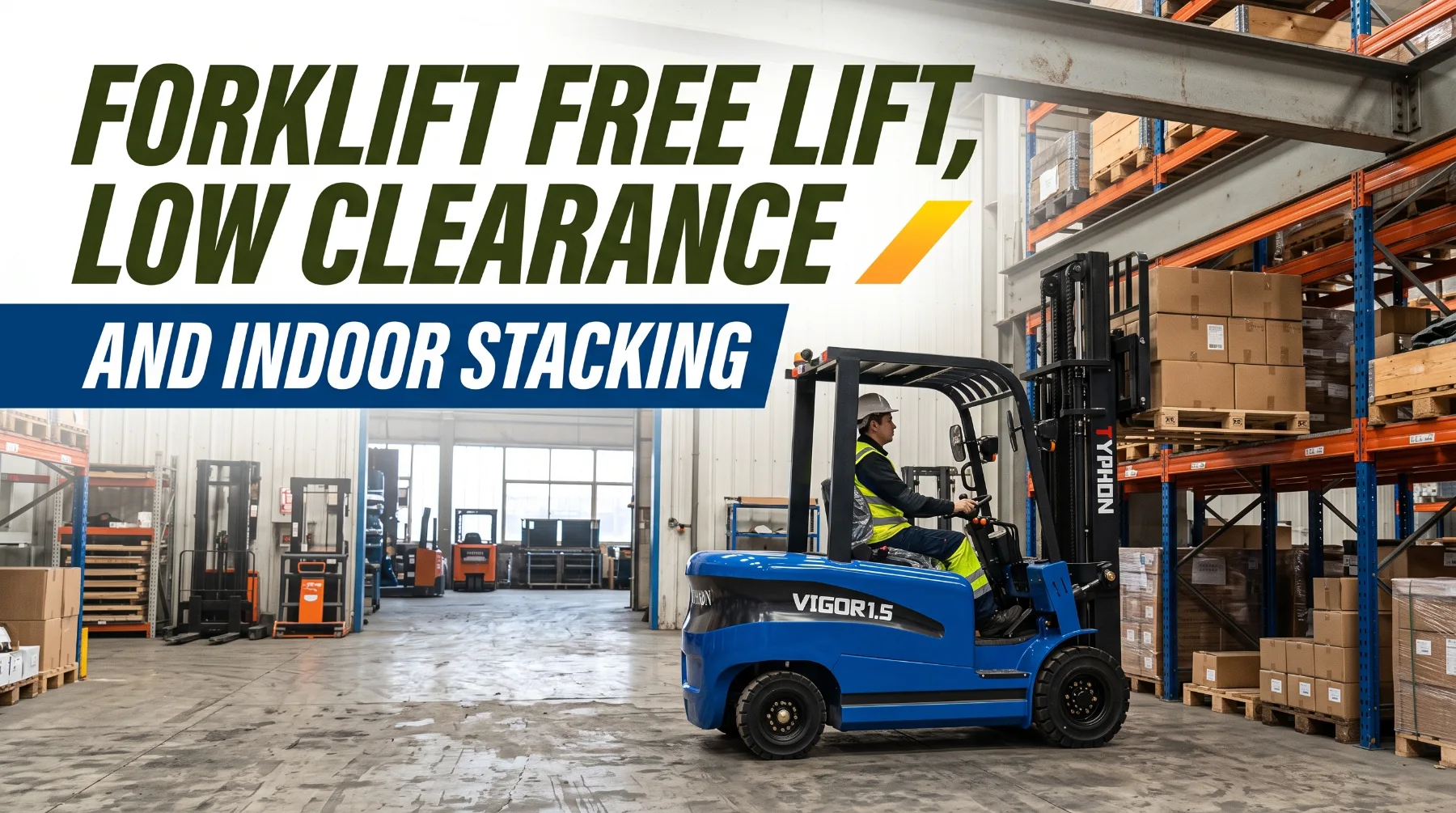
Working beneath a low overhead structure can make a routine pallet placement much more demanding. Roof beams, sprinkler lines, lighting fixtures, and other building components may limit how high the mast can rise, leaving the operator to balance load placement against the available vertical clearance. As the forks climb, the relationship between free lift, mast design, load height, and overall lift height becomes critical to keeping the machine clear of the structure above.
Free lift describes how far the forks can rise before the mast’s overall height begins to increase, making it particularly useful in areas with restricted overhead space. Mast design determines how the sections extend as the forks continue upward, while the load itself adds height that must also fit within the available clearance. Looking at fork height alone is therefore not enough when the machine operates beneath beams, doors, or other low obstacles.
Before placing loads in a restricted area, operators need to account for the full vertical space available above the forklift and its load. Checking overhead measurements, understanding the mast’s lifting behavior, and knowing the machine’s free-lift characteristics can help prevent unwanted contact. Careful height planning keeps pallet placement controlled while protecting both the equipment and the surrounding structure.
What Free Lift Means
Free lift is the distance the forks can rise before the mast itself begins to extend upward, and it depends entirely on the forklift’s mast configuration. On a machine with generous free lift, the forks travel a meaningful distance while the overall height of the mast stays put. That’s a valuable trait when you’re working under a low ceiling or an overhead obstruction, because it lets you raise a load without immediately pushing the top of the mast higher.
The practical benefit is straightforward. More available free lift gives you additional fork movement without an immediate increase in overall mast height, so you can lift and position loads in spaces where a mast that extends early would run out of room. Understanding how much free lift a machine offers is the starting point for judging whether it can work under a given clearance.
Key takeaway: Free lift is the distance the forks rise before the mast extends, and more free lift allows fork movement without immediately increasing overall mast height.
Working Beneath Low Ceilings
Indoor spaces rarely offer clean, uninterrupted overhead room. Warehouses often have low roof sections, structural beams, door headers, sprinkler heads, lighting fixtures, and other overhead equipment, and any of these can define the true clearance in a given area. The lowest obstruction in the path, not the highest point of the roof, is what actually limits the work.
A suitable mast configuration lets operators lift pallets while keeping the necessary clearance from those obstructions. The key is to plan around the complete height of the forklift and its load before entering a restricted area, rather than discovering a clearance problem with the mast already rising. Knowing the machine’s dimensions and the building’s low points in advance turns a potential collision into a routine, controlled lift.
Key takeaway: Beams, door headers, sprinklers, and lighting all define real overhead clearance, so consider the complete height of the forklift and load before entering restricted areas.
Mast Stages and Lift Height
Forklift masts come in different configurations, each offering a different balance of free lift, maximum lifting height, and lowered height. Choosing the right mast depends on both the required stacking height and the available overhead space.
Two-stage and three-stage masts provide different lifting and clearance characteristics. A three-stage mast can offer higher lift while keeping a relatively compact lowered profile, making it useful where both stacking height and overhead clearance matter.
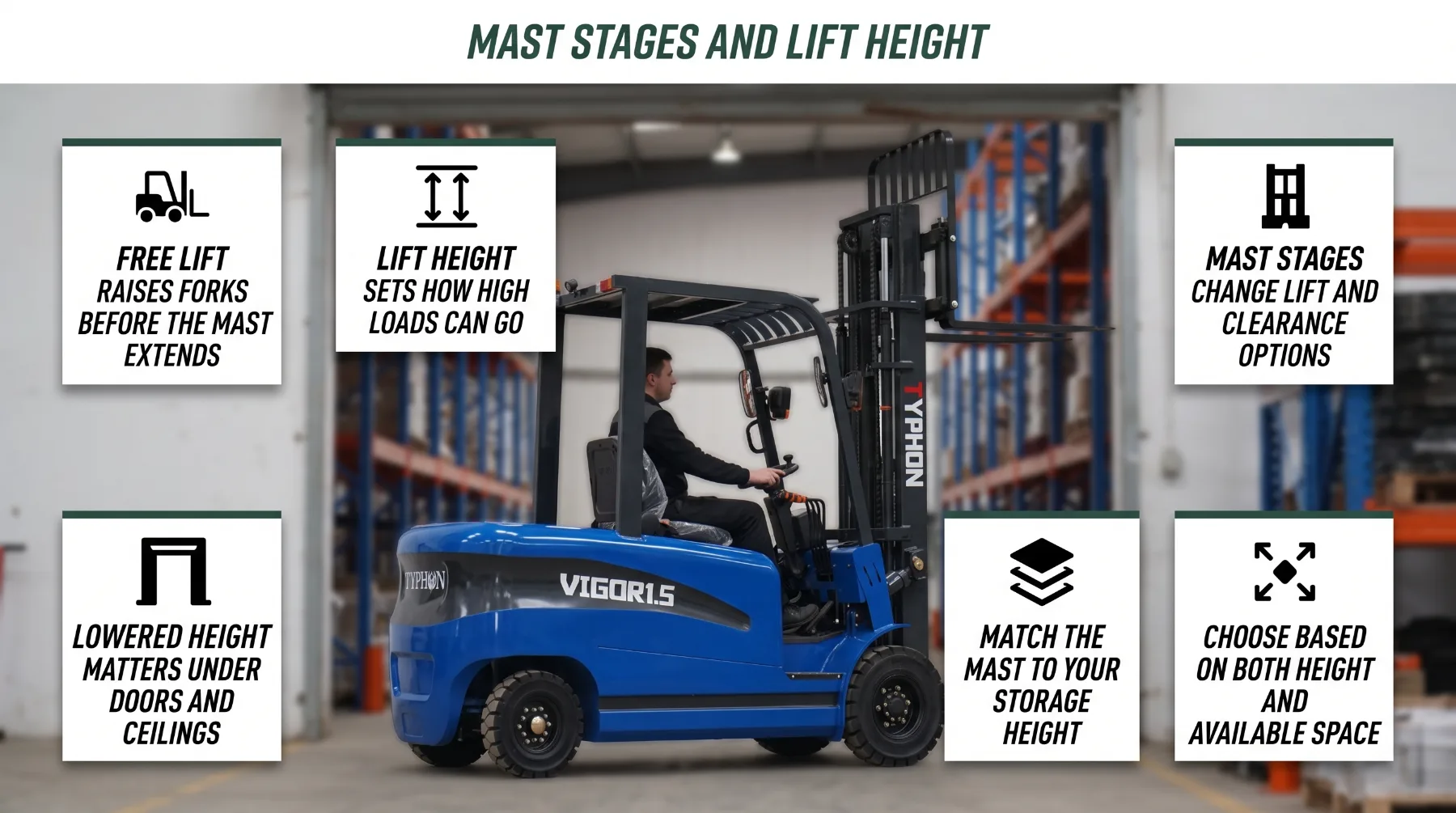
- Free Lift: Allows the forks to rise before the mast extends.
- Lift Height: Determines how high the forklift can place loads.
- Mast Stages: Different configurations provide different lifting and clearance options.
- Overhead Clearance: Lowered mast height matters when working under doors, ceilings, or racks.
- Stacking Needs: Mast selection should match the required storage height.
- Application Match: Choose the mast based on both lifting requirements and available working space.
Key takeaway: Two-stage and three-stage masts offer different combinations of free lift and maximum lift, so weigh required stacking height against available overhead space when selecting a configuration.
Stacking Pallets Indoors
Indoor stacking asks two things of the machine at the same time: enough lift height to place a load at the intended rack or storage position, and enough clearance above the load throughout the lifting process. Meeting one without the other isn’t enough. A forklift that can reach the top rack but has no room to raise the mast beneath a beam can’t complete the placement safely.
Several factors shape whether a stacking operation goes smoothly. Pallet dimensions determine how much space the load occupies, rack height sets the target you’re lifting to, ceiling clearance caps how high the mast and load can go, and load stability governs how carefully the whole lift must be handled. These work together, and a shortfall in any one can complicate the placement. Reading them as a set, before the forks leave the floor, keeps indoor stacking controlled.
Key takeaway: Indoor stacking needs enough lift height to reach the rack and enough clearance above the load throughout, with pallet dimensions, rack height, ceiling clearance, and load stability all shaping the operation.
Load Height and Overhead Clearance
The load isn’t a fixed part of the machine, but it adds directly to the total height that has to pass beneath overhead obstacles. A pallet’s height stacks on top of the fork height, and that combined figure is what actually needs to clear a beam or sprinkler line. It’s an easy factor to underestimate, especially when attention stays fixed on the machine itself.
Not all loads behave the same way, either. Tall pallets, irregular materials, or unstable loads can demand additional clearance compared with compact, evenly stacked ones, whether for the extra height itself or the margin needed to handle them safely. The practical safeguard is to know the combined height of the forks, the load, and the raised mast before moving through any restricted area. That single number, checked in advance, is what keeps the top of a load from meeting an obstruction it can’t pass.
Key takeaway: The load adds to the total height passing beneath obstacles, and tall, irregular, or unstable loads need extra clearance, so know the combined height of forks, load, and raised mast before entering restricted areas.
Floor Space and Positioning
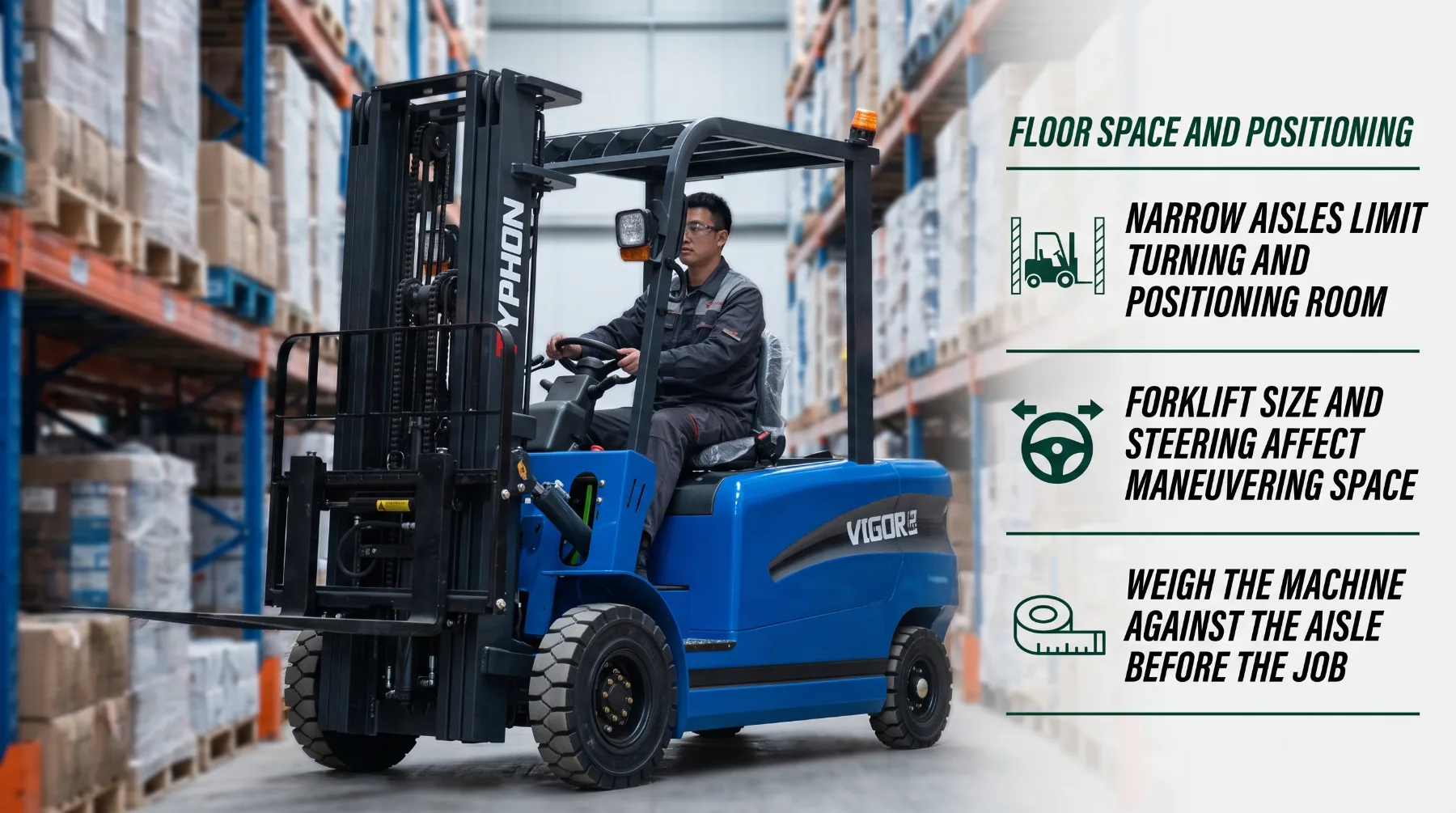
Vertical clearance solves only half the puzzle. Indoor stacking also depends on having enough room at floor level to maneuver and place a load accurately, and tight buildings often restrict that as much as they restrict height. Narrow aisles can limit the turning and positioning space around storage racks, leaving little margin to line the forks up squarely with a rack opening.
Getting placement right in these conditions means several factors have to work together. Forklift dimensions, steering characteristics, aisle width, and load size all influence whether the machine has the room it needs to turn, approach, and position a load precisely. A lift that clears the ceiling comfortably can still struggle if the aisle won’t let it square up to the rack. Weighing the machine against the aisle and the load, before the work begins, is what makes accurate placement possible.
Key takeaway: Narrow aisles limit turning and positioning space, so forklift dimensions, steering characteristics, aisle width, and load size must work together to allow accurate placement.
Conclusion
Forklift free lift is important in warehouses with low ceilings and overhead restrictions because it allows the forks to rise through part of their travel without immediately increasing the overall mast height. Mast configuration determines the available free lift and maximum lifting height, with two-stage and three-stage designs providing different combinations of fork travel and mast extension. Overhead beams, door headers, sprinklers, lighting, and other building components must be considered because the available clearance can limit fork movement before the required stacking height is reached. Load height also affects the required clearance, particularly when handling tall or irregularly shaped loads, while aisle width and machine dimensions must provide enough space to turn and align accurately with the rack. Before operation, the lowest overhead obstruction should be identified along both the travel route and placement area, then compared with the forklift’s free lift, mast height, load dimensions, and required stacking height. Verifying these dimensions together with rated capacity and load stability helps maintain controlled and accurate stacking in confined warehouse environments.
Frequently Asked Questions
What is a forklift free lift?
Free lift is the distance the forks can rise before the mast’s overall height begins to increase. During free lift, the forks move upward while the top of the mast remains at the same height. The amount depends on the mast design and is especially important where ceilings, beams, or sprinkler lines limit overhead clearance. Knowing the free-lift specification helps determine whether a forklift suits low-clearance areas.
Why is free lift important indoors?
Free lift allows the forks to rise within limited vertical space while reducing the risk of the mast contacting ceilings, beams, lights, or sprinkler systems. A forklift with greater free lift can raise a load farther before the mast begins extending upward. This is particularly useful in warehouses where overhead clearance is limited but pallets still need to be positioned at useful heights.
Does mast type affect free lift?
Yes. Mast configurations provide different combinations of free lift, maximum lift height, and extended height. Two-stage and three-stage masts can therefore perform differently in low-clearance areas. A three-stage mast may provide greater free lift and higher reach while remaining relatively compact when lowered. Compare free lift, lowered height, and maximum lift together to match the mast to both ceiling clearance and stacking requirements.
What should be checked before indoor stacking?
Check rack height, ceiling clearance, beams, sprinklers, lighting, load height, mast configuration, aisle width, floor conditions, and forklift capacity. The combined height of the raised load and mast must clear overhead obstacles, while the forklift must have enough space to turn and align with the rack. Confirming these factors before lifting helps keep indoor stacking controlled and within the machine’s operating limits.