

Excavator demolition is the use of an excavator to break, tear down, remove, or sort building materials on a demolition site. The work can be small, like breaking a concrete slab behind a house, or large, like removing parts of an old building, factory, road structure, or warehouse.
An excavator is useful in demolition because it can reach, pull, lift, break, and move material with the right attachment. Instead of using one machine for digging and another for breaking, an excavator can handle many parts of the job by changing tools.
For a beginner buyer or operator, the main thing to understand is this: demolition is not just about machine size. It is about matching the machine, attachment, site condition, operator skill, and safety plan.
Why Excavators Are Used for Demolition Work
Excavators are common in demolition because they offer reach, power, and control. A standard excavator can break concrete, pull down walls, load debris into trucks, sort material, and clear the site after the structure is down.
Another reason excavators work well is attachment flexibility. A bucket can remove debris. A hydraulic breaker can break concrete. A grapple can sort wood, steel, and mixed waste. A shear can cut metal. This makes the excavator a useful machine across many stages of demolition.
Excavators also give the operator better distance from the work area compared with handheld tools. This matters when working around unstable walls, falling debris, sharp material, or broken concrete. Still, distance does not replace planning. Demolition sites can change quickly, so the operator must work slowly and pay attention to how the structure reacts.
For business owners, one excavator with the right attachments can reduce the need for extra equipment. That can save time, but only if the machine is properly sized and the operator knows how to use it safely.
Common Excavator Demolition Attachments
The attachment often decides what kind of demolition work the excavator can do. Choosing the wrong attachment can slow the job, damage the machine, or create safety problems.
A hydraulic breaker is one of the most common demolition attachments. It is used to break concrete slabs, foundations, rocks, pavement, and hard surfaces. It works best when the operator lets the breaker do the work instead of forcing it with too much pressure.
A demolition grapple is used for grabbing, pulling, sorting, and loading material. It is useful when handling wood, scrap, concrete pieces, and mixed debris. Grapples are especially helpful after the main structure has been broken down.
A crusher or pulverizer is used to crush concrete and separate rebar. This can make cleanup easier and reduce the size of material before loading or recycling.
A hydraulic shear is used for cutting steel beams, pipes, tanks, and metal structures. It is more common on larger demolition jobs where metal cutting is a major part of the work.
A standard bucket still has a place in demolition. It can scrape, load, pull loose debris, and clean up the site. For light demolition, a strong bucket may be enough, especially when the work does not involve heavy concrete breaking.
Choosing the Right Excavator for Demolition
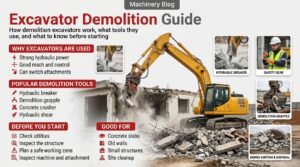
Choosing an excavator for demolition starts with the job size. A small residential job does not need the same machine as a large commercial structure. Bigger machines offer more reach and power, but they also need more space, more transport planning, and stronger ground support.
Reach is important. If the machine cannot reach the work safely, the operator may be forced too close to the structure. That increases risk. For taller structures, contractors may use a high-reach excavator, but this type of machine requires proper training and careful planning.
Hydraulic flow also matters. Attachments like breakers, crushers, grapples, and shears need enough hydraulic power to work correctly. A machine that is too small may run the attachment poorly, even if the attachment can physically connect to the excavator.
Stability is another key point. Demolition work creates side loads, sudden movement, and uneven ground. A stable machine with the right counterweight, track width, and working position is safer and more productive.
For buyers, it is smart to think beyond the excavator itself. Check the attachment compatibility, coupler type, hydraulic lines, operating weight, lifting capacity, and service support. A cheap machine can become expensive if it cannot run the tools needed for the job.
Safety Checks Before Demolition Starts
Demolition work should never begin by simply driving up and breaking the structure. A basic site check can prevent serious problems.
First, inspect the structure. Look for weak walls, hidden basements, overhead hazards, loose roof sections, glass, metal, and material that may fall unexpectedly. The operator should understand what part of the structure will be removed first and where the debris will go.
Second, check utilities. Gas lines, electrical cables, water pipes, and underground services must be located and shut off before work begins. Striking a live utility can cause fire, electrocution, flooding, or major site delays.
Third, plan the exclusion zone. Workers, trucks, and visitors should stay away from the active demolition area. Falling debris can travel farther than expected, especially when pulling walls or breaking concrete above ground level.
Fourth, inspect the machine and attachment. Check pins, hoses, couplers, hydraulic leaks, tracks, windows, mirrors, guards, and alarms. In demolition, small mechanical issues can become serious because the machine is working around sharp and heavy material.
Dust control is also important. Breaking concrete and old building material can create a lot of dust. Water spraying, proper site control, and protective equipment help reduce exposure.
Operator Tips for Better Demolition Work
Good excavator demolition work is controlled, not rushed. The operator should avoid hitting or pulling randomly. Each movement should have a reason.
Start from a safe position. The machine should sit on stable ground, away from the collapse zone. If the ground is soft or filled with debris, it may need to be cleared or compacted before the excavator works from that area.
Work from the top down when removing parts of a structure. Pulling lower sections first can make the structure fall in an uncontrolled way. For larger jobs, the demolition plan should be made by experienced professionals.
Use the attachment correctly. A breaker should not be used like a pry bar. A grapple should not be overloaded beyond the machine’s lifting ability. A bucket should not be used to strike material in a way that damages the boom, stick, or coupler.
Watch the machine’s balance. Demolition often involves reaching forward, lifting heavy debris, and working on uneven surfaces. If the rear of the machine feels light or the tracks shift, stop and reposition.
Keep the work area clean as the job progresses. Too much debris around the tracks can damage hoses, block movement, or create an unstable working surface. Clean handling also makes loading and sorting faster.
When a Mini Excavator Can Handle Demolition
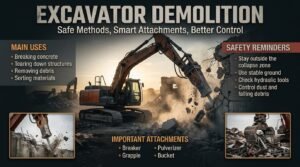
A mini excavator can be useful for small demolition jobs, especially where space is tight. It can work in backyards, small buildings, narrow access areas, landscaping projects, and indoor spaces with the right planning.
Mini excavators are often used to remove concrete paths, small slabs, sheds, block walls, old landscaping structures, and light foundations. With a breaker, grapple, or bucket, a compact machine can do careful work without needing a large excavator on site.
The limit is power, reach, and stability. A mini excavator should not be pushed into heavy structural demolition that needs a larger machine. If the machine is too small, the work becomes slower and more dangerous. The operator may also put extra stress on the boom, arm, hydraulics, and undercarriage.
For buyers, a mini excavator makes sense if most demolition jobs are small, controlled, and in tight spaces. For larger concrete, taller walls, heavy steel, or full building removal, a mid-size or large excavator is usually a better choice.
Conclusion
Excavator demolition is useful because one machine can break, pull, sort, load, and clean up with the right attachment. The best results come from choosing the correct excavator size, using the right tool, checking the site carefully, and working with control.
For beginners, the safest approach is simple: understand the job first, match the machine to the work, and never treat demolition like basic digging.