

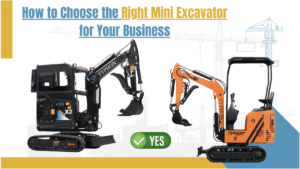
Buying a mini excavator is a major investment that can transform your business’s productivity. These compact machines have evolved from simple digging tools into versatile powerhouses capable of demolition, lifting, and precise grading. However, with dozens of manufacturers and hundreds of models on the market, finding the perfect match for your specific needs can be overwhelming.
Selecting the wrong machine often leads to two outcomes: you either overspend on capacity you don’t need, or you struggle with a machine that lacks the power to complete your jobs efficiently. This guide cuts through the noise. We will break down the essential factors you must evaluate—from operating weight to hydraulic capabilities—to ensure you choose the right mini excavator for your business.
Assess Your Job Site Restrictions
Before looking at specifications, look at where you work. The physical constraints of your typical job sites dictate the size and design of the machine you need. If you cannot get the machine to the digging area, its power is irrelevant.
Space and Access Limitations
For contractors working in residential areas, backyard access is often the primary bottleneck. If you frequently need to pass through standard fence gates or doorways, you need a micro-excavator (typically under 1.5 tons) with retractable tracks. These machines can shrink their width to pass through tight openings and expand again for stability while digging.
If you work on roadways or near existing structures, tail swing is a critical safety factor.
- Zero Tail Swing: The house of the excavator rotates within the width of the tracks. This allows you to work right up against a wall or obstacle without worrying about the rear of the machine hitting it.
- Conventional Tail Swing: The rear of the cab extends beyond the tracks during rotation. These machines generally offer more lifting capacity and stability for their size, but require more clearance to operate safely.
Terrain Conditions
The ground you drive on is just as important as the ground you dig.
- Rubber Tracks: Essential for working on finished surfaces like driveways, sidewalks, and turf. They minimize surface damage and are quieter to operate.
- Steel Tracks: Necessary for demolition sites, rocky terrain, or areas with sharp debris that would shred rubber. They provide superior traction but will damage pavement.
Understanding Operating Weight and Dig Depth
Mini excavators are categorized by their operating weight. This metric is the most reliable indicator of the machine’s power, dig depth, and transportability. Choosing the right weight class ensures you have enough muscle for the job without carrying dead weight.
The 1- to 2-Ton Class
These are the smallest machines, designed for extreme compactness.
- Best for: Landscaping, plumbing, laying irrigation lines, and interior demolition.
- Transport: Can be towed by a standard pickup truck and trailer.
- Limitation: Limited dig depth (usually around 7-8 feet) and lower breakout force.
The 3- to 4-Ton Class
This is the “sweet spot” for many general contractors. These machines offer a balance of power and maneuverability.
- Best for: Utility trenching, foundation work, stump removal, and moving heavy materials.
- Transport: Requires a heavier-duty truck and trailer combination.
- Advantage: They often feature larger cabs with more comfort features, making them suitable for all-day operation. Dig depths typically range from 10 to 12 feet.
The 5- to 6-Ton Class and Above
These machines bridge the gap between compact and standard excavators.
- Best for: Heavy construction, road building, deep utility installations, and large-scale site prep.
- Transport: Usually requires a commercial driver’s license (CDL) and a dedicated hauling vehicle due to weight.
- Advantage: High breakout force and lifting capacity. They can handle heavy attachments like large breakers and compaction wheels with ease.
Evaluate Hydraulic Performance and Attachments
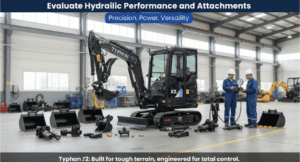
Amini excavator is only as useful as the tools it can power. While a bucket is standard, the ability to use hydraulic attachments turns your excavator into a multi-purpose tool carrier.
Hydraulic Flow Rates
Pay close attention to the hydraulic flow rate, measured in gallons per minute (GPM), and the pressure (PSI). Standard flow is sufficient for buckets, thumbs, and basic augers. However, if you plan to use high-performance attachments like flail mowers, mulchers, or large soil conditioners, you may need a machine equipped with “High Flow” auxiliary hydraulics.
Coupler Systems
How often will you change attachments? If you switch between a bucket and a breaker multiple times a day, a quick coupler system is non-negotiable.
- Manual Couplers: Require the operator to leave the cab and physically remove pins. It is cheaper but slower.
- Hydraulic Quick Couplers: Allow the operator to change attachments from the safety of the cab in seconds. This maximizes uptime and productivity.
The Importance of a Thumb
For many operators, a hydraulic thumb is essential. It allows you to grab and place objects like rocks, logs, and concrete chunks. Trying to clear land or perform demolition without a thumb is inefficient and frustrating. Ensure the machine you choose is either equipped with a thumb or is “thumb-ready” with the necessary plumbing.
Operator Comfort and Technology
Operator fatigue is a real cost to your business. A tired operator is slower, less precise, and more prone to accidents. Modern mini excavators offer various features to keep operators productive throughout a long shift.
Cab vs. Canopy
- Open Canopy (ROPS): Less expensive and offers easy entry/exit. Suitable for mild climates or seasonal work.
- Enclosed Cab (HVAC): Essential for working in extreme heat, cold, or rain. A climate-controlled cab keeps the operator comfortable and protects them from dust and noise. It also increases the resale value of the machine.
Control Patterns
Most modern machines use ISO (excavator) joystick controls, which are ergonomic and intuitive. Some older or specific models may use SAE (backhoe) patterns. Look for machines with a pattern changer valve, which allows you to switch between ISO and SAE controls. This feature is vital if multiple operators with different preferences will be using the same machine.
Budget and Total Cost of Ownership
The purchase price is just the beginning. You must consider the total cost of ownership (TCO) to make a smart financial decision.
New vs. Used
Buying new gives you the latest technology, full warranty protection, and zero hours on the engine. It is the safest bet for a primary production machine. Buying used can save significant upfront capital, but it carries the risk of hidden wear and tear. If buying used, inspect the undercarriage, pins, and bushings carefully, as these are expensive to repair.
Maintenance and Serviceability
Look for a machine designed for easy maintenance. Open the engine hood and check access to daily service points. Can you reach the oil dipstick, fuel filter, and air filter easily? If routine maintenance is a hassle, it often gets neglected, leading to downtime.
Also, consider the dealer support network. A bargain machine is a liability if you cannot get parts quickly. Choose a brand with a strong local presence and a reputation for parts availability.
Conclusion
Choosing the right mini excavator requires an honest assessment of your current workload and your future goals. Don’t just buy what is in stock; buy what fits your business. Start by defining your size and weight constraints, then prioritize the hydraulic power needed for your attachments. Finally, factor in operator comfort and long-term maintenance costs.
By taking a strategic approach to this purchase, you ensure that your new mini excavator becomes a profitable asset rather than a financial burden. We are dedicated to helping you navigate these specifications to find the equipment that delivers reliability and performance on every job site.