

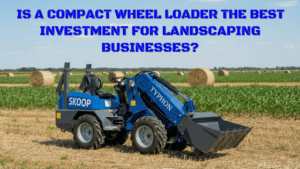
In the competitive world of professional landscaping, efficiency is the only currency that matters. Every minute spent moving material, loading trucks, or grading a site translates directly to your bottom line. For years, the skid steer loader has been the default choice for contractors thanks to its compact size and zero-turn capabilities. However, a major shift is occurring in the industry. More business owners are taking a hard look at their fleets and realizing that a compact wheel loader might actually be the superior investment.
Choosing between a skid steer and a compact wheel loader isn’t just about preference—it comes down to physics, economics, and long-term operational costs. While both machines have their place, the compact wheel loader offers distinct advantages in visibility, lifting capacity, and ground speed that can revolutionize how a landscaping crew operates. If you are expanding your fleet or replacing an aging machine, understanding where the wheel loader shines is crucial. Let’s break down daily job capabilities, fuel costs, and return on investment (ROI) to see if this machine is the missing piece in your growth strategy.
Daily Job Capability and Versatility
This version keeps the exact same flow as your original draft but removes the extra wordiness so it reads faster. The primary role of a landscaping loader is efficiently moving materials like mulch, soil, or sod. This is where compact wheel loaders truly stand out. Unlike skid steers that drag their wheels to turn, wheel loaders articulate in the middle so the rear tires perfectly follow the front. For landscapers working on finished lawns, this is a game-changer. It prevents the instant turf damage a skid steer can cause, letting you work quickly without wasting time on costly repairs.
Beyond preserving the grass, their longer wheelbase and dedicated counterweights offer superior lift capacities for safely handling heavy pavers or large stone blocks. The operator also sits higher up, providing excellent visibility over the bucket. This elevated vantage point makes stacking materials or loading high-sided dump trucks safer and more precise.
The Speed Advantage on Job Sites
Time is money, and in the landscaping business, travel speed is a critical factor often overlooked during the purchasing process. Compact wheel loaders are generally faster across the ground than their skid steer or compact track loader counterparts. While a typical skid steer might top out at 7-10 mph, many compact wheel loaders can travel at speeds up to 20 mph.
This speed differential might seem minor on paper, but on a sprawling commercial site or a large residential estate, it adds up quickly. Consider a project where the stockpile of mulch is located on the street, but the planting beds are 300 yards away in the backyard. A wheel loader can make that round trip in half the time of a tracked machine. Over the course of a day, moving 50 yards of material, that speed advantage can save hours of labor.
Furthermore, because wheel loaders use a steering wheel and foot pedal (similar to a car), they are often more intuitive for new operators to learn. The smooth ride provided by the pneumatic tires and oscillating chassis means operators can maintain higher speeds comfortably, whereas a skid steer on rough terrain can be a jarring experience that forces the operator to slow down to avoid spilling the load.
Analyzing Fuel Efficiency and Operating Costs
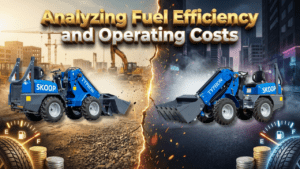
When you look at the total cost of ownership, fuel consumption and tire wear are two of the biggest variable expenses. Here, the compact wheel loader is the undisputed champion. The engineering behind a wheel loader is inherently more efficient. The engine only needs to power the drivetrain and hydraulics to move forward; it doesn’t need to fight the friction of skidding tires against the ground to turn.
In contrast, a skid steer requires high horsepower and fuel burn to execute turns, as it must overcome the resistance of its own tires gripping the surface. Industry data often shows that a compact wheel loader can use up to 30% less fuel than a comparably sized skid steer performing the same tasks. Over a year of daily operation, these fuel savings alone can amount to thousands of dollars, directly improving your profit margins.
Tire wear is another area where the wheel loader saves money. Skid steer tires are subjected to immense friction and abrasion every time the machine turns. On abrasive surfaces like asphalt or concrete, a set of skid steer tires might only last 400 to 600 hours. Wheel loader tires, which roll rather than scrub, can last significantly longer—often exceeding 2,000 to 3,000 hours depending on the application. This drastic difference in consumable costs makes the wheel loader a far more economical machine to run long-term.
Return on Investment (ROI) and Resale Value
The upfront purchase price of a compact wheel loader is often higher than that of a skid steer, which can be a hurdle for some business owners. However, a smart investment decision looks at the lifetime value of the asset, not just the sticker price. When you factor in the lower fuel consumption, extended tire life, and reduced maintenance costs (due to fewer moving undercarriage parts), the operational cost per hour is significantly lower for a wheel loader.
Additionally, compact wheel loaders tend to hold their resale value exceptionally well. The market for used wheel loaders is strong because they are durable machines with engines that don’t have to work as hard as those in skid steers. An engine in a wheel loader often sees a longer service life because it operates at a more consistent RPM range without the constant high-load spikes required for skidding turns.
When calculating ROI, consider the specific nature of your contracts. If your business focuses heavily on hardscaping, snow removal, or large-scale material placement, the efficiency gains of a wheel loader will pay for the higher initial cost relatively quickly. The ability to use the machine for snow removal in the winter—where its speed and road-friendliness are unmatched—further extends its utility, turning a seasonal landscaping tool into a year-round revenue generator.
Is It the Right Choice for You?
Ultimately, choosing a compact wheel loader comes down to your specific business model. If you spend most of your time squeezing through narrow backyard gates, a mini skid steer or compact track loader is still your best bet. But if your crew handles larger residential builds, commercial maintenance, or municipal contracts, a wheel loader makes a massive difference.
It perfectly bridges the gap between small loaders and heavy earthmovers, giving you the finesse for delicate turf work, the muscle for heavy hardscaping, and the speed to keep the job moving. By cutting down on operator fatigue, fuel costs, and turf repair, it does more than just move dirt—it moves your bottom line. Before you buy another skid steer just out of habit, test drive a compact wheel loader. The added comfort and efficiency might be exactly what your business needs to scale.