

If you work in construction, landscaping, or utilities, you know the feeling. You’re standing on a job site, staring at a project that is way too big for a shovel and a wheelbarrow, but way too tight for a full-sized 20-ton excavator.
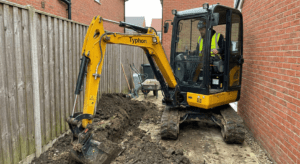
Maybe it’s a backyard drainage issue where the only access is a narrow garden gate. Maybe it’s digging footings right up against an existing foundation where one wrong move with a big machine means expensive damage.
For years, this was my personal headache. I spent way too much time trying to force big equipment into small spaces, or worse, renting machines that had been beaten within an inch of their lives by the previous user. The sloppy controls, the questionable hydraulics—it was always a gamble.
Eventually, you realize that to grow your business and protect your sanity, you need the right tool. You need to stop looking at rentals and start looking for a new mini digger for sale.
It’s a significant investment, sure. But after spending thousands of hours in the cab of various machines, I can tell you that the shift toward compact, powerful equipment isn’t just a trend; it’s a necessity for modern mini digger construction. Let’s talk about why making that investment now makes sense, and what you should actually be looking for when you go to kick the tires.
Why “New” Matters (More Than Just Shiny Paint)
There’s always the temptation to save a buck and buy used. I’ve been there. I once bought a ten-year-old 3-ton machine that looked okay on the outside. Six months later, I blew a main hydraulic pump in the middle of a deadline-critical job. The money I “saved” on the purchase price vanished in repairs and downtime in about 48 hours.
When you are looking at a new mini digger, you aren’t just buying a machine with no scratches. You are buying predictability.
The Evolution of Hydraulics
The biggest difference between a mini digger built today and one built fifteen years ago isn’t the engine horsepower; it’s the hydraulic finesse.
Older mini diggers often felt jerky. You’d try to feather the controls to grade a smooth trench bottom, and the boom would jump. Today’s machines, even the more affordable ones, utilize much more sophisticated hydraulic systems. This means smoother multi-functioning (swinging, curling the bucket, and booming up all at once without the machine bogging down). This smoothness translates directly to speed and accuracy on the job site.
The “Zero Tail Swing” Revolution
If you do residential work, this is non-negotiable. Fifteen years ago, you always had to worry about the counterweight hanging off the back of the machine. You’d be focused on the bucket, swing around to dump spoil, and crunch—the back of the cab just took out a client’s fence post.
Many modern new mini diggers feature zero or minimal tail swing designs. The house of the machine rotates within the width of the tracks. This dramatically reduces operator stress. You can park right next to a wall and work without constantly checking your six.
Warranty as a Business Tool
For a small contractor, a warranty isn’t just paperwork; it’s a shield against bankruptcy. Knowing that for the next two or three years, any major powertrain failure is someone else’s financial problem allows you to bid on jobs with confidence.
Real-World Applications: Where These Machines Shine
It’s easy to think of a mini digger as just a “shrunken down” big excavator. But that’s not quite right. They are specialized tools for surgical work. In modern mini digger construction, versatility is key.
The Backyard Beast
This is the classic application. Retractable tracks are a feature on many smaller units (usually under 2 tons). You hydraulically suck the tracks in to fit through a standard 40-inch doorway, drive into the backyard, and then widen the tracks back out for stability once you start digging. Try doing that with a backhoe loader.
Utility and Drainage Work
When replacing a collapsed sewer lateral in an established neighborhood, you are often working around gas lines, water mains, and expensive landscaping. The precision of a modern mini digger allows you to surgicaly expose utilities without causing a massive disaster.
The Tool Carrier Concept
If you are only using your mini digger with a bucket, you are leaving money on the table. The real power is in the auxiliary hydraulics.
-
Hydraulic Thumb: In my opinion, a thumb is mandatory. It turns your digger into a hand. You can place armor stone for retaining walls, rip out stubborn brush, or handle demolition debris neatly.
-
Auger: Stop renting two-man post hole diggers that break your back. An auger on a mini digger drills perfect deck footings in seconds.
-
Breaker (Hammer): Ideal for busting up old concrete patios or driveways before repouring.
A Look at the Market: Enter Typhon Machinery
When you start shopping for a new mini digger for sale, you run into the usual suspects—the massive, legacy brands that have been around for fifty years. They make great machines, undoubtedly. But their pricing has gone through the roof.
For the average owner-operator, dropping $70,000+ on a 3-ton machine is a terrifying prospect. You have to move a lot of dirt to pay that note every month.
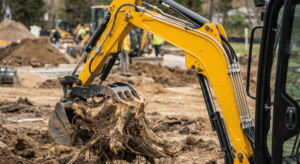
This opens the door for newer players in the market who are focusing on value. I’ve been keeping a close eye on Typhon Machinery recently.
The Typhon Approach
I’m generally skeptical of new brands, but what interests me about Typhon is their approach to the “essentials.” In talking to guys who have run them, the consensus seems to be that Typhon Machinery isn’t trying to win an award for the fanciest touchscreen display in the cab. They are trying to build a workhorse.
They seem to focus on marrying reliable, proven engines (often recognizable names like Yanmar or Kubota, depending on the model) with straightforward hydraulic systems.
Why It Matters to You
If you are a small business, you need a machine that starts every morning and digs holes. You don’t necessarily need ten different programmable operator profiles or heated air-ride seats.
Typhon Machinery seems to be targeting that sweet spot of providing a robust, new mini digger with a solid warranty, for significantly less capital investment than the “big names.” For a lot of contractors trying to maximize ROI, that’s a very compelling argument. They are stripping away the luxury fluff and leaving the functional iron.
The Practical Buying Checklist: Kicking the Tires
Whether you are looking at a Typhon or any other brand, don’t just read the spec sheet. Specs don’t tell you what a machine is like to live with. When you go to look at a machine, here is what you need to actually do:
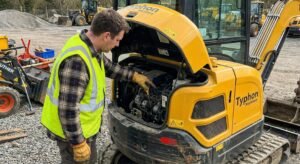
1. The “Mechanic’s Handshake” (Serviceability) Before you even turn the key, open the engine hood and the side panels.
-
Can you reach the oil filter without dislocating your shoulder?
-
Is the fuel water separator easy to drain?
-
Are hydraulic check ports buried under a rat’s nest of hoses? If a machine is hard to service, you (or your crew) won’t service it. It’s that simple. Good engineering accounts for the guy holding the wrench.
2. The Track Tension Test Look at the undercarriage. How is track tension adjusted? Is it a simple grease cylinder fitting? Look at the idlers and rollers. They should look beefy. The undercarriage takes the most abuse; if it looks cheap on the showroom floor, it won’t last a year in the mud.
3. The “Feel” Test (Pilot Controls) Sit in the seat. Are the joysticks hydraulic pilot controls, or are they mechanical linkages? You want pilot controls. They offer much smoother, low-effort feedback. Start the machine and run it at low idle. Try to perform two actions at once—boom up and swing slowly. Does the engine almost stall? Does one function jerk to a stop? A good hydraulic system should be able to blend functions smoothly, even at lower RPMs.
4. Auxiliary Hydraulics Flow Ask hard questions about the auxiliary circuit. If you plan to run a brush cutter or a large hammer, you need to know the Gallons Per Minute (GPM) and pressure (PSI) of that auxiliary line. Don’t assume every “3-ton” digger has the same hydraulic guts.
Conclusion: Investing in Your Capability
Making the jump to buy a new mini digger is a big step for any business. It’s a commitment.
But stop and calculate how much you spent on rentals last year. Calculate how many jobs you turned down because you couldn’t fit your current equipment into the access point. Calculate the hours lost to repairing old iron.
The construction landscape is only getting tighter and more demanding. Having a reliable, precise, and powerful compact machine in your fleet isn’t a luxury anymore; it’s how you stay competitive. Whether you opt for a premium legacy brand or a value-focused contender like Typhon Machinery, the key is to get in the seat, test the metal, and find the tool that helps you get the job done. Go move some dirt.